December had blown into town and stolen its warmth. Nights returning to the motel were an agony for Jay, even wearing a jacket. You could hear the air’s sharpness in the way leaves scraped the pavement, the same way it scraped his bare cheeks on his ride home. Then the chill would ebb and the warmth return, only to flee again in a few days. At least it wasn’t cold when it rained.
Time was sweeping by now that he had something, someone, to think about besides work. It would soon be Christmas. The thought surprised him, that he might care how near or far away a holiday was. Another thing to mark how rooted Rumor was now in his thoughts.
Careful, Jay, a part of him warned. It might not be a good idea.
Should he buy her a gift? She didn’t seem the type to value mere things, but he wanted to show her, in some visible way, how he felt.
On a Monday morning he rode to Celia’s house out by the river. The water looked a dull steel color, cold under sunless clouds. He leaned his bike against a tree in her front yard and knocked softly, hesitant at first. He frowned and knocked again, louder, just as Celia opened the door.
“Jay,” she stated in a dry voice. “How you be?”
“All right. Listen, you got a moment?”
“Pull off my hat,” she smirked. “Crabs ain’t gonna catch themselves.” But her shoulders loosened and she tilted her head. “I’ve got a moment.”
He followed her in. As they stood in the living room, each sizing up the other, he spotted it: the wide fanner basket of grass and fronds and pine needles, hanging over her mantle.
“Could you make me one of those?” he blurted. “I’ll pay what you want for it. I know it’s not cheap.”
He’d had the thought nearly a week now, that Rumor might like it as a gift, even if he’d have to work an extra week at Ed’s to make up the cost. And it would help Miss Celia, too, without letting on he’d listened in on her troubles.
But she only laughed. “Do you now?” Something almost like bitterness flashed in her eyes. “Well, I can’t help you. I never learned to weave sweetgrass.”
“Oh,” he stammered. “Really? I thought it was something they passed down here—a tradition, or…”
Celia sighed. “Maybe, honey. Maybe. But I never learned. I was always counting down the day till I got out of here.”
Jay didn’t know what to say to that. He looked around, avoiding her eyes, till his glance rested on the piano. “I was going to give it to her, for Christmas. It’s the only idea I have.”
“Rumor?” Cee smiled, the bitterness fading a little. “You don’t need to give her nothing. She won’t expect it from you. Just be there with her.”
Jay shook his head. Then nodded. It wasn’t what he wanted to hear, but there was a good while left for him to think it through.
* * *
In odd moments, on his way to and from the Loblolly or Coffin Road, Jay found himself peering over his shoulder, checking the road. Nothing. He knew it was silly, but it became a reflex as the weeks in this town had passed. His mind saw that damn cop everywhere.
More than once, when he had let his guard down, it had happened: he would spot that gimlet gaze and rustbit hair as Glass sped by in his cruiser. Beyond a doubt, the man was stalking him. He hadn’t been stopped or questioned, not since their second encounter. But every time he saw the black and white hull of a Crown Vic, there would be Ira Glass staring back at him—especially when he was with Rumor.
Wednesday morning. The road was empty today, free of the cop’s presence. He felt relieved, though something in him found it unnerving.
He arrived at the diner half an hour late, having overslept. Bursting in the door, his eyes swept the dining room: no sign of Ed. Good. If he could sneak back to the kitchen without being seen—
Jay froze. There at the bar, coffee in hand, sat Ira Glass.
A spark licked through his veins and seared his limbs. “There you are,” Rumor called, spotting him. Glass, too, turned and locked eyes with him, nodded once.
She rose from her spot at the bar and walked to him. “Where you been?” she teased. “Ed says you’re late.”
He didn’t answer, only stared at the cop. Glass had turned to his coffee again, showing his stiff back.
“What did you tell him?”
“Who?” Rumor’s brow creased.
“The cop. Was he harassing you? What’d he say?”
She frowned. “Nothing. Just talked about the weather.” She gave a sly smile. “I think he likes me.”
“I’ll bet he does.” Jay scanned the room again, then showed her to a table. “You want anything? Or did you just come for me?”
“Coffee, I guess. But I did want to talk to you…”
He brought her a steaming mug and sat beside her. He knew it would get him in hot water with Ed, but he was already late as it was. He was jarred, too, by Glass showing up out of the blue. In all the time Jay had worked there, he’d never seen the cop come in.
Rumor frowned, followed his glance. “What’s the deal, Jay? You know him or something?”
He wrenched his eyes away and met hers. “Nothing. I’ll tell you later. What did you want to talk about?”
Her eyes clouded for a moment, then cleared and bored into him. “I want to do something for Miss Celia. I think we should help her.”
Jay was surprised, but not terribly. It felt like something she might say. “What do you have in mind?”
She bit her lip and leaned forward. “Okay, look, hear me out. Her property tax is about due, and she’s coming up short again. I know you got a lot of money saved up. All she needs is a little.”
His shoulders tensed. “How much are we talking?”
“Only…well, about nine hundred. Not even that. Bit less.”
Nine hundred. Jay whistled low. Was she really asking him for money? Now he was surprised. But it was a way to give them something both—Cee and Rumor. Both more substantial than a basket, and less. Hadn’t Cee told him Rumor wouldn’t want anything he could buy?
But no, what was he thinking? He’d worked hard for that money. It was his way out. He’d been crippled for so long without the Buick, without an escape plan.
Jay tried to speak but his voice came out hoarse. He cleared his throat, tried again. “Why don’t you give her the money? I mean…I thought your family was rich.”
“My family?” She turned and squinted sidelong at him.
He hesitated. She did own Indicum, didn’t she? The biggest plantation in the town, even if only a parcel of its former size, and little more than hunting land now. Hadn’t she said that the day they first met? That she had always lived there?
“I don’t have money, Jay. I don’t even have a job.”
“Then how do you get by?”
“I get what I need.” He expected a hard look from her, given her tone, as if daring him to press the subject. But she looked vulnerable. Jay felt lost. He was definitely missing some important subtext to what she was saying.
What had Celia told him? You can’t hear a word from her she didn’t want to speak.
“Just think about it, Jay. That’s all I’m asking. If she don’t get it somewhere she’ll lose her home.”
He stood. “Listen, I want to help. I do. But…you don’t know what you’re asking. It’s not just the Buick. I just—I need—”
His voice fell off. He didn’t know what he needed.
She clasped his hand. “It’s okay. Just thought I’d ask.”
She held his gaze. Jay was too ashamed to break it. He felt worthless, but helpless as well, trapped in a moment he’d never asked for.
“Will you spend the night again?” she asked. His eyes widened. He nodded slow. “It’s gonna be warmer this weekend.”
Rumor slipped outside, leaving him to pay her bill. Ira Glass, too, stood and followed her. He gave a stiff nod as he passed Jay. “Be seein’ you,” he said with a flash of a mocking smile.
Jay could not speak a word.
* * *
Come Friday, he biked out to the thrift store on Bell Drive for a blanket, making sure to wash it with the week’s load of clothes at the laundromat. When he rose next morning and stepped out into the motel lot, the day indeed felt warm. The kind of warmth only felt in full sunlight, but still a welcome change. He checked his phone: the high sixties. He breathed in deep, taking in the late-year scents of burnt pinewood, tea olive, moldering leaves.
He’d decided not to spend just a night with her, but the whole day. The roads opened up for him as he pedaled, showing hidden things he’d never noticed. The black and white of a fox squirrel. Red sprays of yaupon berries.
Even the crepe myrtle sang in a mild breeze as he arrived. Bronze and yellow leaves clung to its branches, crisp and bright amid the green. Cheery and inviting.
He’d grown to love that tree. The tree and the house and the whole span of Coffin Road.
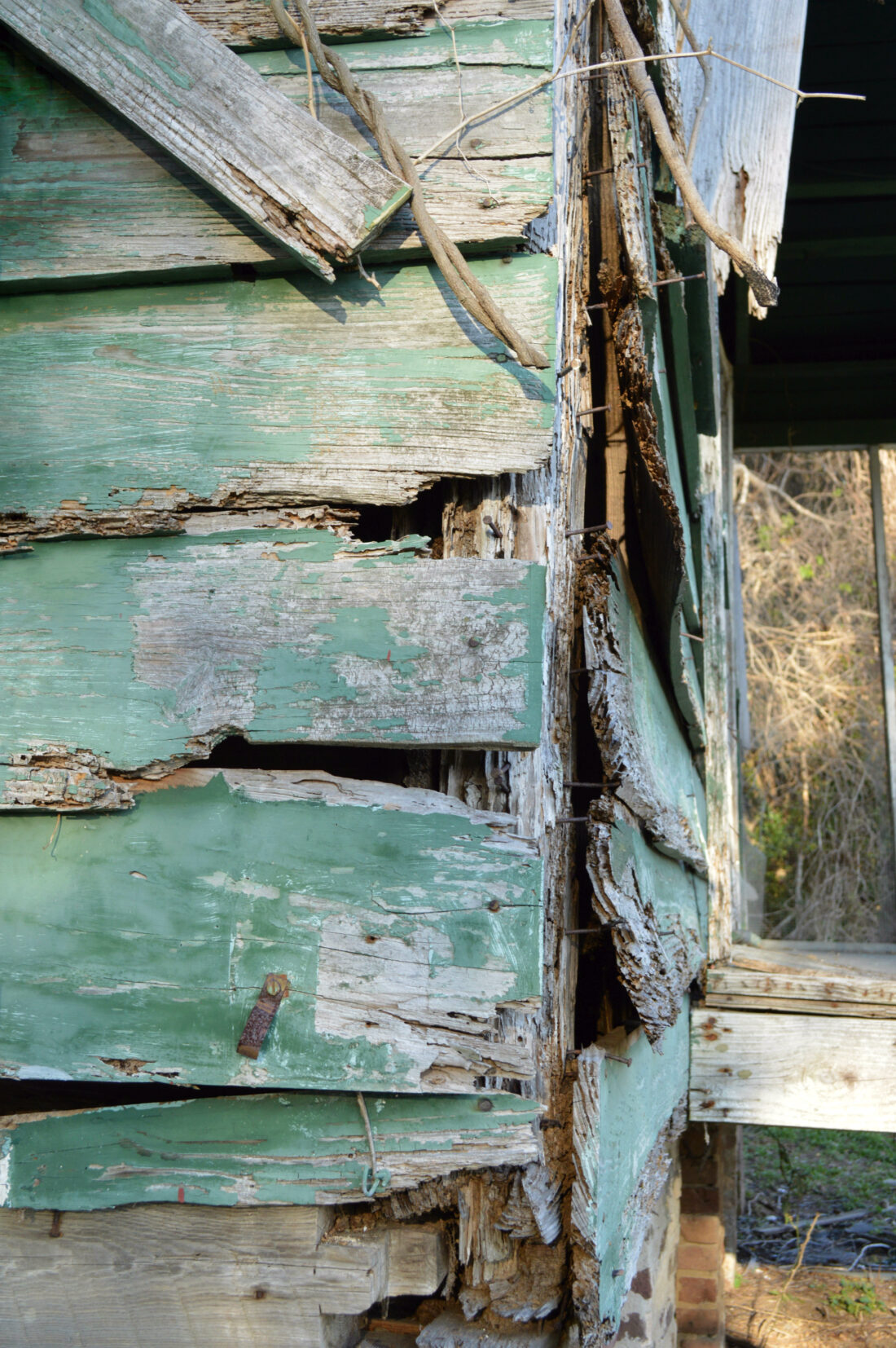
He slipped off the bike and leaned it on the brick chimney where it couldn’t be seen from the road. Stairs groaned as he climbed up them, holding the blanket, kicking away what looked like owl droppings. She was already there, upstairs, just where he’d found her before.
She turned. Her glance fell on the blanket and she gave a winning smile. “You remembered.”
“I did.” He glanced over their shabby surroundings. “I must be catching your unique brand of crazy, though.”
“Don’t worry. You won’t freeze.”
He believed her. He wasn’t sure why, but he did.
“Listen,” he began. “About the cop that day at the diner… He’s the one who gave me the ticket. I think he’s following me. Stalking me. It…kind of creeps me out.”
Her gaze blurred as she took this in. “And you think…” she finally said. “Is he dangerous?”
His skin rippled. It was the first time he’d considered that. “I’d just feel better if you stayed away from him.”
She stepped back. “I can look out for myself.”
“I know you can. I know. Sorry…can we just talk about something else?”
So they did. He lay on the wood floor next to her and bathed in the sun, drinking in the dark dance of pines in the breeze. And her voice itself, seeming to rise from her lips and drift out the window, only to return bearing things back to him from the world outside, visible to his mind. Squareback crabs burrowed in pluff mud. Hawks soared, pelicans waited. Coffeebean snails clung to marsh grass. And things dared to stir in freshwater holes where alligators denned.
She spoke, too, of the Simmonds family, who had owned Indicum from before the Revolution, then had made a fortune mining phosphorus after the war—and their forced labor—was lost. How they had sold off all the land across from Coffin Road, half the plantation in its time.
She spoke of the people who’d lived in this place the longest and knew the most about it: not the Simmonds, but the ones enslaved by them, who had bought up parts of this place at auction with money once saved to buy themselves. The same people now being driven off as lot after lot was developed into houses, ones the Simmonds themselves might have found spacious.
And she spoke of Celia Gadsden, last of the holdouts along the river. Of her and Mosquito, who had left long ago to fare his own way before his sister was ever born, too proud now to ask for help beyond a night or two on her couch, once in a blue moon. Then Celia would take him out crabbing or fishing and they would sit side by side on her dock as he drank a can of some ditchwater lager. Both of them silent as the fish.
“It sounds sad,” said Jay.
“Is it?” She met his eyes, hair sprawling down over half her cheek. “He has a home even if he ain’t always there.”
Jay nodded, but pushed the thought away. It sank below the waters of his thought where it was safe. Evening drew on. A silence had fallen now, and he felt as if the blanket were a raft, carrying them downstream somewhere he couldn’t imagine. The wind rustled in the crepe myrtle a moment, a soft sighing sound, then fell away. Or did it?
He sat up. Not the tree—tires on the road.
He wasn’t sure… He’d heard no motor, but it could have been a newer, quieter engine. Jay stood and look out. Saw lights, but no clear shape, through the ranks of pines.
“What is it?” she asked.
“I don’t know.” He shook his head then knelt beside her again.
The night was cold, but the house blocked out most of the wind. They slept pressed close together, keeping the other warm, fingers twined like the lace of her scalloped white blouse.
“You’re right,” he spoke in the morning, first thing when they woke. “I want to do something for them.”
She opened her eyes and met his. “I want to do something,” he said again, “but I can’t give her money. Maybe I can get Ed to throw an oyster roast in her benefit. It’s the right time of year for it, and I think a good crowd would come. It might nearly be enough.”
She tilted her head and a smile sprouted from her lips. Her brown eyes shifted green.
“We could make it work.”
She kissed him slow. Her lips were bitter, almost like coffee. She pulled away to meet his eyes and he leaned in slow for another.